
Auction: 26001 - Orders, Decorations and Medals
Lot: 156
Sold By Order of a Direct Descendant
Family group:
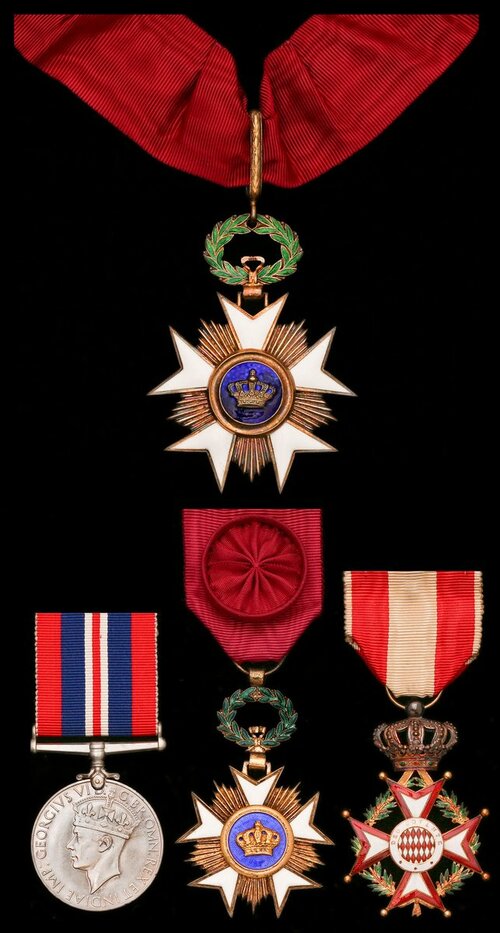
An interesting Second World War group of four awarded to Flight Lieutenant E. F. Dadson, Royal Air Force Volunteer Reserve, who commanded S.O.E.'s Belgium 'T' Section in 1940-41
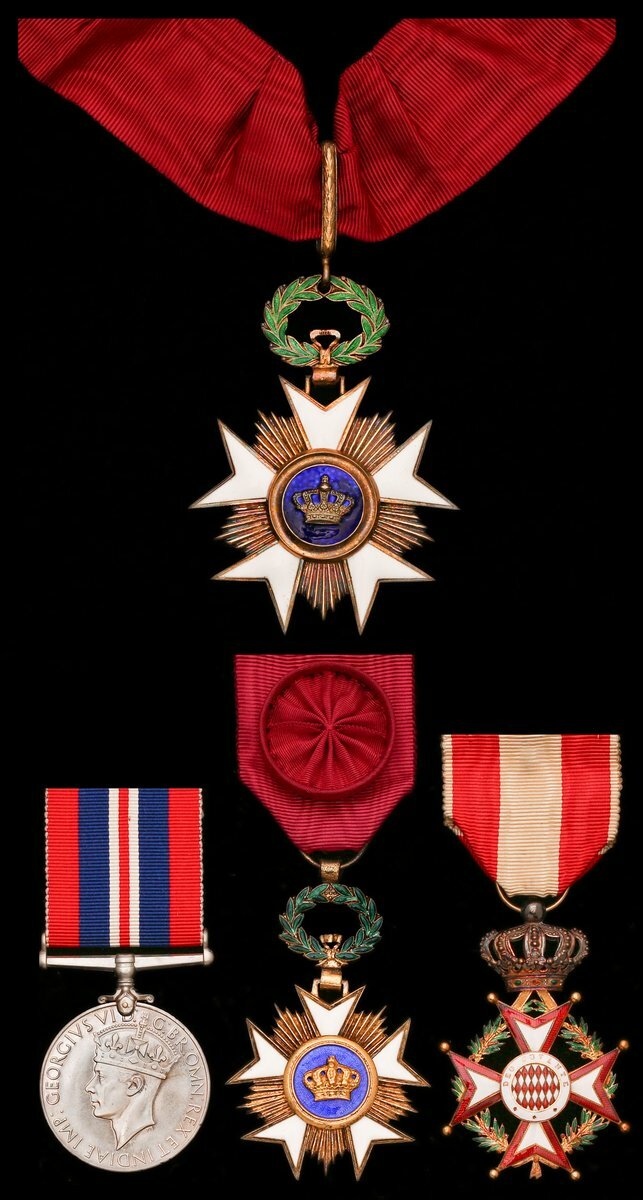
War Medal 1939-45, in its O.H.M.S. forwarding box addressed to 'Flight Lieutenant E. F. Dadson, 2 Devonshire Square, London E.C. 2', with related ticker tape print out; Belgium, Order of the Crown, Commander's neck badge, silver-gilt and enamel, in its Piret, Bruxelles case of issue; Belgium, Order of the Crown, Officer's breast badge, gilt and enamel, in its De Greef, Bruxelles case of issue; Monaco, Order of St. Charles, Knight's breast badge, in gold and enamel, with silver-gilt crown suspension, generally good very fine (4)
The Great War campaign pair awarded to Lieutenant J. V. Dadson, Royal Army Pay Corps
British War and Victory Medals (Lieut. J. V. Dadson), mounted as worn, together with related miniature dress medals, good very fine (4)
Eric Fulton Dadson was born in Hampstead, London, on 30 May 1903, the son of James Verey Dadson, and was educated at Christ's Hospital. When the Germans invaded Belgium in May 1940, he was the manager of the Antwerp gas works. Making his way back to England, he was commissioned in the Royal Air Force Volunteer Reserve and quickly collared by the fledgling Special Operations Executive (S.O.E.), then under the auspices of Hugh Dalton, the Minister of Economic Warfare. A natural choice - for he possessed both lingual skills and local knowledge - he was appointed head of the organisation's Belgium 'T' Section, which had its offices in Norgeby House in London's famous Baker Street.
Effectively starting from scratch, Dadson had a battle over the next 10 months to find suitably qualified agents, largely in consequence of the Free Belgians in London proving reluctant to help him enlist Flemish-speaking recruits. Nor did the threat of Nazi reprisals help his case.
Nonetheless, by May 1941, he was ready to infiltrate his first agent, Emile Fromme, who had been recruited from the ranks of the Chasseurs Ardennais. He was parachuted into Belgium in May 1941 and is said to have formed a group of saboteurs in Verviers. Sadly, he was later captured and executed.
Other agents recruited by Dadson numbered a Jesuit priest, Father Jourdain - codename 'Opinion' - who was originally approached to garner help from the Belgian church hierarchy, but who in fact volunteered to act as an agent himself, when Dadson met him at the Roman Catholic seminary in Buxton, Derbyshire. Jourdain and a wireless-operator, Armand Leblicq, were dropped by parachute one night in July 1941, but with tragic consequences: Leblicq's was killed when his parachute snagged on their aircraft's tailplane.
In common with S.O.E. operations in the Netherlands, those in Belgium also started to fall victim to the Abwehr's counter measures, the 'playing back' of captured wireless sets proving especially effective. In fact, by late 1942, of 45 agents and 18 wireless operators dispatched to Belgium, only 13 remained at large.
Dadson, however, had resigned from his post about a year earlier, in consequence of a heavy-handed response to a supposed security breach, his anger being expressed in a lengthy memo addressed to 'CD' - Sir Frank Nelson, the Head of S.O.E. - in November 1941:
'On Wednesday, the 15th of October 1941, I was submitted to a series of indignities, to wit: one man searched my person, two men searched my office (and incidentally read confidential documents therein) and three men searched the house in which I am at present living.
The excuse given for this amazing action was a note which I sent to four colleagues who, by their functions in your organisation, were already aware of the information given in it.
I am at a loss to understand why a note written and distributed within the precincts of this office should be deemed sufficient excuse to suspect the writer of criminal intentions. As I must unhappily conclude that instructions for the action taken emanated from yourself who, as far as I knew, had not, up to that time, any particular reason to doubt my integrity, I was and am very disturbed to find that you were ready to extend to me no confidence at all.'
His place being taken by a Grenadier Guards officer, Claude Knight and, later still, by Hardy Amies, the famous fashion designer.
For his own part, Dadson's expertise in the energy sector led to his undertaking war work for an electricity company, as Security Officer for Edmundson's Corporation. He crossed swords with Lord Rothschild in May 1942, who was working for M.I.5., which led to a confidential opinion on the services of Dadson being questioned. The word came back that he was to be trusted (HS 9/387/5 refers), and in the post-war era he became successively general manager, chairman and president of the Continental Gas Association.
His services to Belgium were recognised by his appointment to Officer of the Order of the Crown, 'in recognition of services rendered during the war' (London Gazette 31 July 1951, refers), and subsequently to that of Commander of the Order. He retired to the Isle of Wight, where he died in February 1995. For his miniature dress medals, please see Lot 288.
James Verey Dadson - his father - was born in Kilburn, London in 1876. Commissioned in the Army Pay Corps, he was embarked for France in June 1916, where he gained advancement to the temporary rank of Captain. He died in Uxbridge in December 1940.
Subject to 20% VAT on Buyer’s Premium. For more information please view Terms and Conditions for Buyers.
Sold for
£800
Starting price
£400
Watch, listen and bid as if you were in the room. Now available for auctions worldwide.
Click here to bid live
An exclusive and confidential service for the discerning collector or vendor.
View the Gallery
Download every Spink catalogue on your iPad, iPod or iPhone using free Spink app.
Download From iTunes© 2026 Spink & Son. All rights reserved.