
Auction: 26001 - Orders, Decorations and Medals
Lot: 104
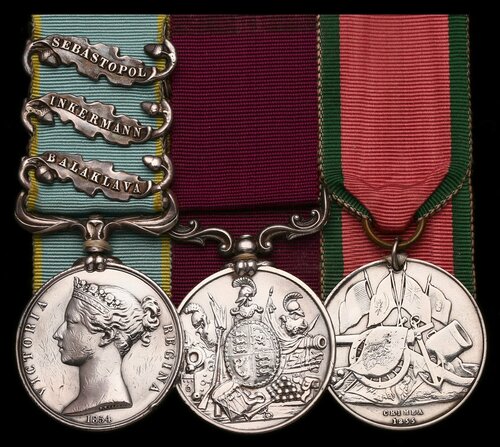
Three: Private J. Lahey, 6th Inniskilling Dragoons
Crimea 1854-56, 3 clasps, Balaklava, Inkermann, Sebastopol (Pte J. Lahey. 6th Dr Gs.), engraved naming; Army L.S. & G.C., V.R. (1256 Jas Lahey 6th Dragoons); Turkish Crimea 1855, British issue, fitted with replacement ring suspension, very fine (3)
Provenance:
Glendining's, 19 May 1965, Lot 359.
James Lahey was born at Donaghmore, Co. Cork, Ireland in 1834 and was a domestic servant before he attested for the 6th (Inniskilling) Dragoons at Newcastle-upon-Tyne on 2 November 1853. He served with the 6th Dragoons as part of the Heavy Brigade in the Crimea and was present at the Battles of Balaclava and Inkermann and the actions before Sebastopol. He re-engaged at India for a further 12 years' service on 2 November 1865 and was awarded his L.S. & G.C. Medal on 22 February 1872 and this was sent to Sandhurst on 10 August 1872. Lahey served until 19 January 1875 when he was time expired. He intended to live at Camberley (Cambridge Town), Surrey. Noted in the book by Roy Dutton as probably rode in the charge.
The Charge of the Heavy Brigade at Balaclava:
The Regiment was deployed to the Crimea in April 1854 but during the voyage the regiment's transport ship Europa sank with the loss of the commanding officer, Lieutenant Colonel Willoughby Moore, and 17 of his men. Lieutenant Colonel Henry Dalrymple White took over command of the regiment and led it in action at the Battle of Balaclava in October 1854.
The first assault line consisted of the Scots Greys and one squadron of the Inniskillings, a total of less than 250 sabres. Only when the RSMs declared themselves happy with the alignment did Scarlett order his bugler to sound the 'Charge'. The idea of a charge conjures up images of the Light Brigade dashing forward at speed but Dragoons were larger men with much heavier equipment so their charge was more of a trot. Floundering at obstacles such as ditches or coppices they headed towards the massed ranks of Russian cavalry, pressing on inexorably at a mere 8 miles an hour. Slow they may have been but the effect of these heavy cavalrymen slamming into the much lighter Russian cavalry stunned their enemy.
A letter from a captain of the Inniskillings illustrates the melee which followed:
Forward-dash-bang-clank, and there we were in the midst of such smoke, cheer, and clatter, as never before stunned a mortal's ear, it was glorious! Down, one by one, aye, two by two fell the thick skulled and over-numerous Cossacks....Down too alas! fell many a hero with a warm Celtic heart, and more than one fell screaming loud for victory. I could not pause. It was all push, wheel, frenzy, strike and down, down, down they went. Twice I was unhorsed, and more than once I had to grip my sword tighter, the blood of foes streaming down over the hilt, and running up my very sleeve... now we were lost in their ranks - now in little bands battling - now in good order together, now in and out."
In the words of Colonel Paget of the Light Brigade "It was a mighty affair, and considering the difficulties under which the Heavy Brigade laboured, and the disparity of numbers, a feat of arms which, if it ever had its equal, was certainly never surpassed in the annals of cavalry warfare, and the importance of which in its results can never be known.
Subject to 20% VAT on Buyer’s Premium. For more information please view Terms and Conditions for Buyers.
Sold for
£1,600
Starting price
£550
Watch, listen and bid as if you were in the room. Now available for auctions worldwide.
Click here to bid live
An exclusive and confidential service for the discerning collector or vendor.
View the Gallery
Download every Spink catalogue on your iPad, iPod or iPhone using free Spink app.
Download From iTunes© 2026 Spink & Son. All rights reserved.