
Auction: 26001 - Orders, Decorations and Medals
Lot: 63
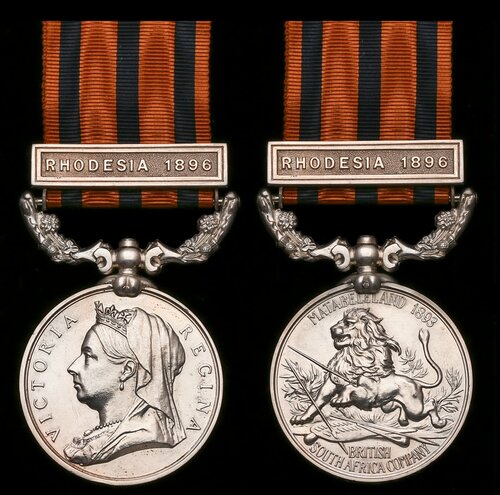
The British South Africa Company Medal awarded to Corporal L. L. Ballantine-Dykes, Salisbury Horse, who later served as Captain of 'B' Troop of the Mashonaland Mounted Police during the ill-fated 'Jameson Raid'; he latterly served as Inspector of Police for Bulawayo
British South Africa Company 1880-1896, Matabeleland 1893 reverse, 1 clasp, Rhodesia 1896 (Corpl. L. L. Ballantine-Dykes. Salisbury Horse), light contact marks very fine
Lawson Leigh Ballantine-Dykes was born at Isel Hall, Cumberland, Cumbria on 30 October 1864. He was originally gazetted to be a Lieutenant in the 3rd Battalion Border Regiment on 11 May 1886. He emigrated to Rhodesia in the early 1890's, joined the Salisbury Horse, and served as a Corporal in operations in Matabeleland between 16 October - 24 December 1893, a total of 262 members of the Salisbury Horse took part in this campaign. He later served with the Mashonaland Mounted Police and was in Command of B Troop of the Mashonaland Mounted Police taking part in the Jameson Raid of 1895-96 under the command of Lieutenant Colonel the Honourable H. F. White (late Major Grenadier Guards).
On 29 October 1895 White who was Chief Staff officer and the third of the White brothers, arranged to establish a police camp at Maliet farm near Pitsani, now Pitsane Photlokwe, which was inspected and approved by Jameson a day or so afterwards. It was ideally situated, a coach stop on the route between Mafeking and Bulawayo, just 3 miles from the Transvaal Republic (ZAR) border and with a permanent water supply, a quiet spot out of the way for training.
Two days following Jameson's appointment, Inspector Straker with a force of eighty men of the Matabeleland Mounted Force and two Maxims moved out of Bulawayo. Most people, including the police, thought they were being sent to protect the railway construction work if there was trouble from the tribes. Straker and his men arrived at Pitsani on 30 November 1895 and were followed by other detachments including one from the Mashonaland Mounted Police under Sub-Inspector Tomlinson. In all 380 of the mounted police, then called the British South Africa Company Police, left the country, leaving just forty in Matabeleland under Inspector Southey. About 100 men of the BBP transferred under Lieutenant Colonel Raleigh Grey, less than the 200 that Jameson hoped for, but remained at Mafeking.
The force that rode out from Pitsani camp on the 29 December 1895 numbered close to 600 and consisted of almost 400 Rhodesian Police who were employed by the Charter Company, 120 men recruited at Mafeking and some Cape 'Boys'. They had six Maxims, two 7 pound mountain and one 12 and half pound guns. The plan was a three day hard ride to Johannesburg where the majority, the disenchanted Uitlanders, the mainly British expatriate community, would rise up on this catalyst against the Transvaal authorities and tip the republic neatly into the welcoming and grateful arms of the Empire. To the participants they were embarked upon a great adventure and one which they were led to believe had 'official' sanction.
It was an enormous political and military gamble, the stakes were exceedingly high and success would undoubtedly have changed the course of history in Southern Africa. It is left to speculation quite how much of the plan the Colonial Secretary in London, Joseph Chamberlain, knew in advance, but the overthrow of a sovereign government was the ultimate goal of this exploit.
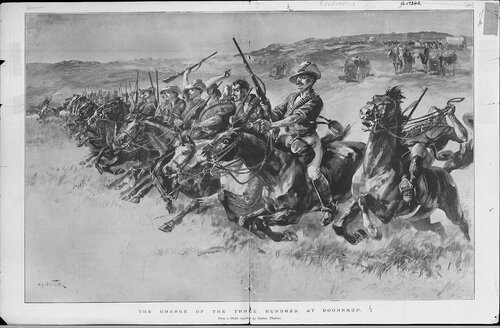
On 2 January 1896, the force stopped at day break at a farm called Doornkop in the Transvaal. They were much in need of rest and had ridden the 170 miles without sleep and under constant harassing fire. They were just two hours' ride from Johannesburg and before them lay the alluring sight of their prize and yet it was not to be ; for here they would receive the bitter news that the city had not risen to support them, they were surrounded, outnumbered and cut off.
Jameson's force had never enjoyed the element of surprise and had been monitored by Transvaal commandos from the moment they crossed the border and for two days continuously they had fought a running rear-guard action, sustaining losses in both dead and wounded.
At Doornkop the fighting intensified and the number of casualties rose to 65 killed and wounded. Unaided Jameson's position was untenable and his small force was doomed against such determined and overwhelming opposition. Surrender became their only option and this took place at 8.00pm when following the burial of the 16 British dead, the remainder were led away to prison in Pretoria.
Ballantine-Dykes served as a J.P. upon his return to England and died at Llangar, Crowthorne, Berkshire on 29 September 1945.
Subject to 20% VAT on Buyer’s Premium. For more information please view Terms and Conditions for Buyers.
Sold for
£1,700
Starting price
£1600
Watch, listen and bid as if you were in the room. Now available for auctions worldwide.
Click here to bid live
An exclusive and confidential service for the discerning collector or vendor.
View the Gallery
Download every Spink catalogue on your iPad, iPod or iPhone using free Spink app.
Download From iTunes© 2026 Spink & Son. All rights reserved.