
Auction: 26001 - Orders, Decorations and Medals
Lot: 57
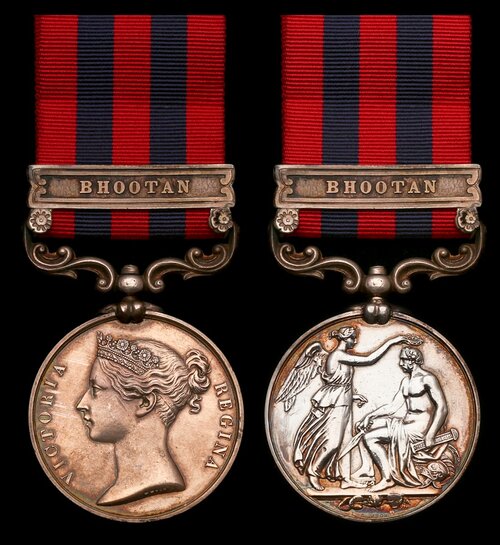
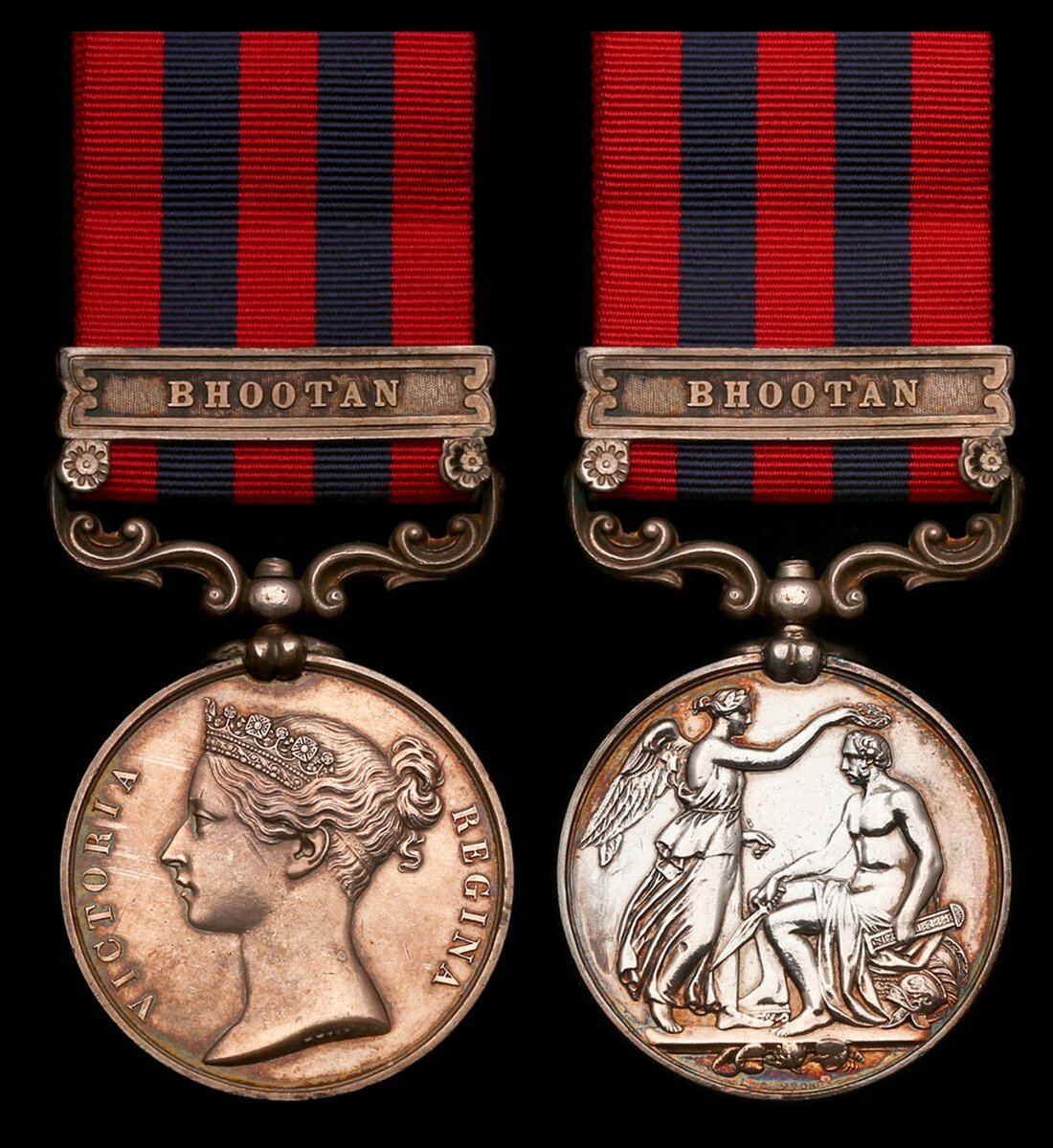
India General Service 1854-95, 1 clasp, Bhootan (Captn. F. Allen, 18th N.I.), good very fine
Ex-Brigadier Brian Parritt Collection.
Frederick Allen was born in London in 1830, the son of William Houghton Allen, a well-known bookseller and publisher. Nominated for a cadetship in the Bengal Infantry in June 1852, he was duly appointed an Ensign and embarked for India that September, initially to take up an appointment in the 14th Native Infantry at Dinapore.
India and the Mutiny
Having then exchanged to the 26th N.I. and the 42nd N.I., he had been advanced to Lieutenant in August 1854 and was appointed Adjutant of the Scinde Rifle Corps. Witnessing active service in the Sonthal Rebellion in 1856-57 Allen was appointed Adjutant of the Calcutta Native Militia. He appears to have remained similarly employed throughout the Indian Mutiny, thereby failing to qualify for the Medal, but, in the fullness of time, and by which stage his re-titled Militia unit was known as the 18th Native Infantry, he did indeed qualify for his only campaign medal, namely the India General Service Medal for the Bhootan operations of 1864-66.
Bhootan
On that occasion, the 18th N.I. were assigned to Daling Column, i.e the one furthest west, and its role was to seize Daling and protect the flank of the expedition from any attack from Sikkim or Tibet. The campaign began on 28 November 1864 when the Daling Column crossed the Tista River near Jalpaiguri. The column seized several small stockades without resistance until, on 5 December, it reached Ambiokh, a village immediately below the fort of Daling. Early the next morning the British force advanced, while guns and mortars shelled the fort from Ambiokh. A barricade was taken without difficulty, and from there the attacking party advanced to the foot of the ascent. There they were exposed to volleys of stones and arrows and lost two men killed and several wounded, including two officers. Two 5 ½ inch mortars were then brought up, but the explosion of a powder cask killed three officers (two of them from the 18th) and four men. An Armstrong gun was then brought up from Ambiokh; after a few rounds it breached the defences and the 18th N.I. occupied the place, whilst the Bhutanese evacuated it from the opposite side.
General Dunsford left a garrison at Daling and moved the rest of his column down to the plains, with the intention of moving eastwards. On 29 December a reconnaissance party of 150 men was sent to examine Chumarchi Pass; it was attacked by the Bhutanese and twelve men were wounded. The main body having arrived on the last day of December, on New Year's Day 1865 Dunsford opened the attack by shelling the fort; after a dozen rounds, the enemy were seen "flying away over the hills." One officer rushed to the rear of the village and killed 13 of the enemy, though himself suffering losses of two killed and three wounded.
The other three columns were equally successful and the Field Force was about to be disbanded when, at the end of January, the Bhutanese counter-attacked. The heaviest blow fell at Dewangiri in the east where, on the night of the 4-5 February 1865, the British retreated from their position. Apparently the guide got lost, shots were fired and, in the darkness of the jungle, panic spread, resulting in the abandoning of guns and wounded. There was also a strong attack on Chumarchi, which also had to be evacuated.
General Mulcaster was sacked and replaced by General H. Tombs, V.C., C.B., while Brigadier General J. M. B. Fraser Tytler, C.B., superseded Dunsford in command of the left Column. Tytler immediately made a personal visit to all the outposts in his area and, after seeing everything for himself, decided to attack the main enemy stronghold on the Bala Pass. One force was ordered to the enemy right in a night flank move, and then move right up behind the enemy position. The remainder made a frontal attack. After a brisk bombardment, the sepoys of the 18th and 19th N.I charged. General Tytler described the assault as 'The finest rush he had ever seen ... on arriving at the fort, which was palisaded to a height of 28 feet, the troops swarmed up, sword in hand and killed the men who formed garrison.' The British lost three killed and twenty wounded, the enemy loss was forty-six. Tytler's column then captured Buxa recaptured Chumarchi without resistance.
Epilogue
Allen was promoted to Captain in September 1866, Major in September 1872 and Lieutenant-Colonel in September 1878, and attained the rank of Colonel and Commandant of the 18th Native Infantry in October 1881. He was finally placed on the Retired List as a Major-General in February 1885; sold together with detailed research.
Subject to 20% VAT on Buyer’s Premium. For more information please view Terms and Conditions for Buyers.
Sold for
£340
Starting price
£240

Watch, listen and bid as if you were in the room. Now available for auctions worldwide.
Click here to bid live
An exclusive and confidential service for the discerning collector or vendor.
View the Gallery
Download every Spink catalogue on your iPad, iPod or iPhone using free Spink app.
Download From iTunes© 2026 Spink & Son. All rights reserved.