
Auction: 24111 - Orders, Decorations and Medals - e-Auction
Lot: 673
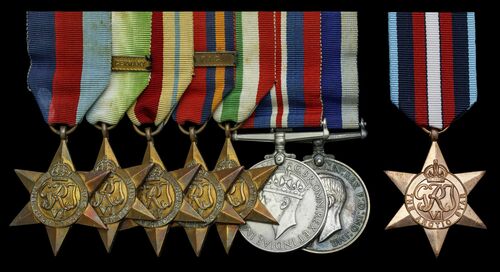
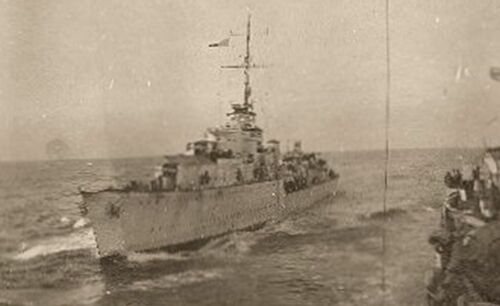
A Second World War campaign and long service group of eight awarded to Ordnance Artificer 1st Class H. Thursby, Royal Navy, who survived the loss of the destroyer H.M.S. Somali on the Arctic run in September 1942
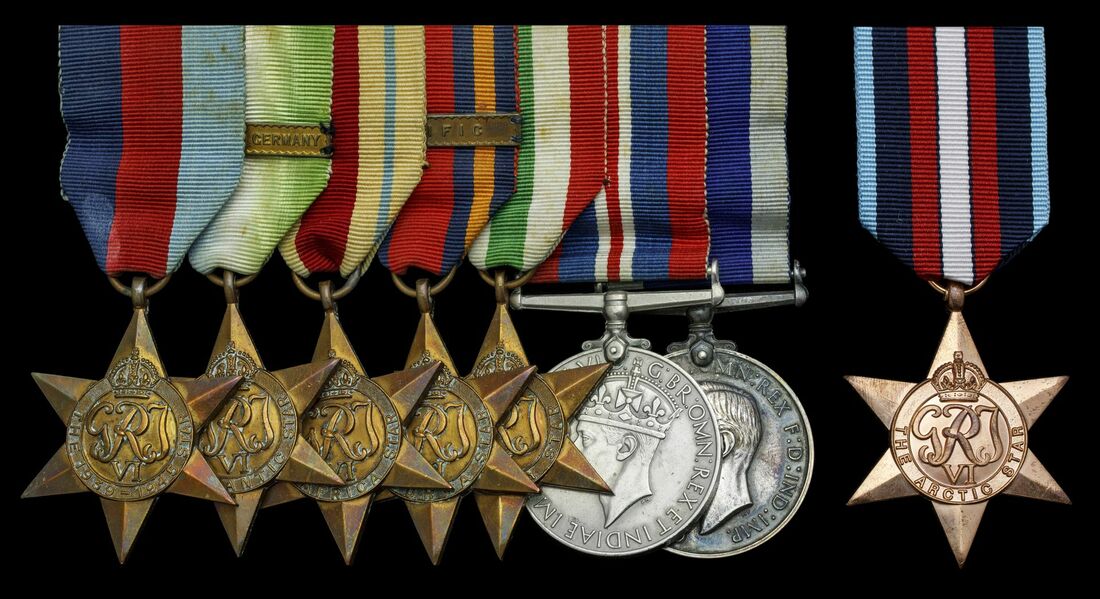
1939-45 Star; Atlantic Star, clasp, France and Germany; Arctic Star; Africa Star; Burma Star, clasp, Pacific; Italy Star; War Medal 1939-45; Royal Navy L.S. & G.C., G.VI.R., 1st issue (MX. 47125 H. Thursby, O.A. 1, H.M.S. Nelson), excepting the Arctic Star, mounted as worn, generally good very fine (8)
Herbert Thursby was born in Darlington, Co. Durham on 20 January 1907 and entered the Royal Navy as an Acting Ordnance Artificer 4th Class in March 1928.
On the outbreak of hostilities in September 1939, he was serving as an Ordnance Artificer 2nd Class in the battleship H.M.S. Iron Duke, and he remained similarly employed until removing to the destroyer Somali in August 1942.
In the interim, Iron Duke was heavily damaged at Scapa Flow by enemy aircraft attacks in October 1939 and in March 1940, and had to be beached.
Thursby was again on the sharp end of enemy action on 20 September 1942, when Somali (Lieutenant-Commander C. Maud, D.S.C., R.N.) was hit by a torpedo from the U-703 whilst escorting Arctic convoy QP-14.
The resultant explosion blew the torpedo tubes over the side, cut all the port side main stringers, and left the ship only held together by the upper deck and starboard side as far as the keel; in addition, the port engine collapsed through the bottom of the ship and the engine and gear rooms filled with water.
The leaking bulkheads on either side were promptly shored up but there was no light or power except from an unreliable auxiliary diesel generator which powered the bilge pumps. The armed trawler Lord Middleton having then closed the crippled destroyer and taken off most of her crew, 80 officers and ratings remained aboard as a skeleton crew. Somali was then taken in tow by her consort Ashanti and crawled towards Iceland at just 7 knots.
On the night of 23-24 September, after journeying over 400 miles with Somali's plates groaning terribly, a blue flash amidst a snow squall marked the snapping of the tow line: shortly afterwards, when picked up in a searchlight, the destroyer 'folded in half like a hinge' and slipped beneath the waves: just 35 of her skeleton crew were plucked from the icy waters, a rescue operation that led to the award of an Albert Medal.
Postscript
Following Somali's loss, Thursby served in the battleship Nelson from October 1942 until June 1944, in which period he was awarded his L.S. & G.C. Medal. He also witnessed extensive action in the North Africa, Sicily and Italy landings, in addition to Normandy in June 1944, when Nelson was seriously damaged by a mine.
His final wartime appointment was on the King George V from October 1944 until the end of hostilities, in which period the famous battleship carried out some notable bombardments in the Far East, including one off Okinawa. Thursby finally came ashore as an Ordnance Artificer 1st Class in March 1953.
Subject to 20% VAT on Buyer’s Premium. For more information please view Terms and Conditions for Buyers.
Sold for
£800
Starting price
£280

Watch, listen and bid as if you were in the room. Now available for auctions worldwide.
Click here to bid live
An exclusive and confidential service for the discerning collector or vendor.
View the Gallery
Download every Spink catalogue on your iPad, iPod or iPhone using free Spink app.
Download From iTunes© 2026 Spink & Son. All rights reserved.