
Auction: 24111 - Orders, Decorations and Medals - e-Auction
Lot: 632
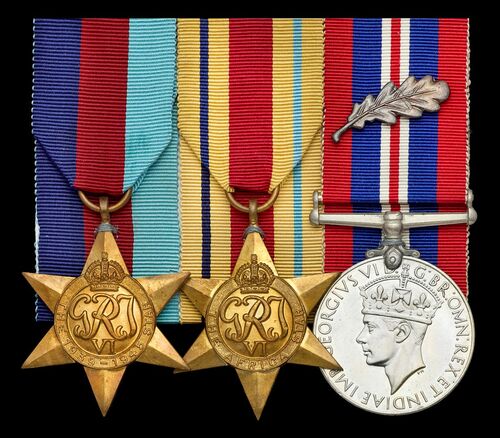
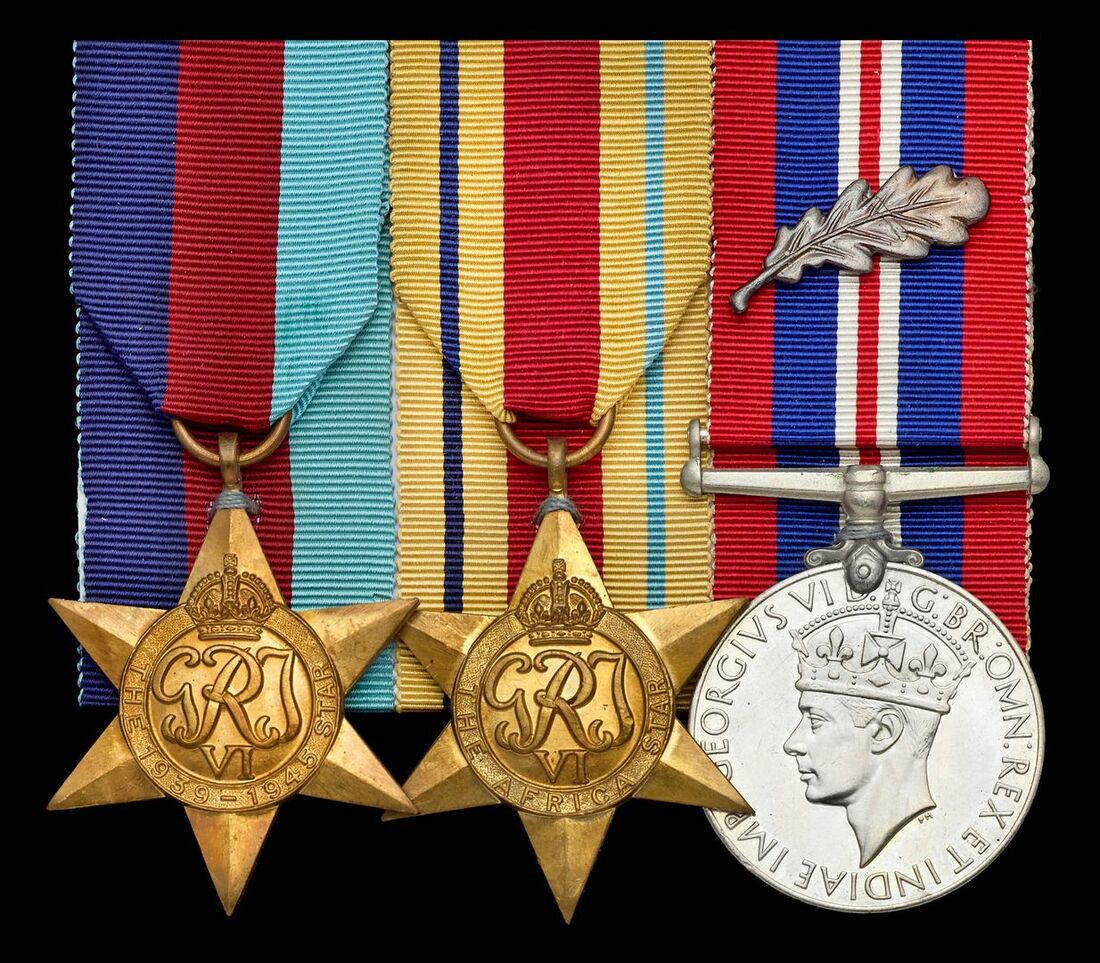
(x) A Second World War casualty group of three to Major C. E. J. Godwin, Royal Tank Regiment, who was 'mentioned' in 1942 for his action at Gazala
1939-1945 Star; Africa Star; War Medal 1939-45 with M.I.D. oakleaf, all privately impressed (Major C. E. J. Godwin 42 Bn. R.T.R.), extremely fine (3)
M.I.D. London Gazette 15 December 1942
'This officer was badly wounded in the shoulder in the fighting in 150 Bde. Box, Gazala May, 30 1942. He however insisted in returning to his tank and continued to lead his squadron until all his tanks were destroyed. The Box was eventually overrun. Godwin was captured and it is understood died of wounds about the same time.'
Charles Edward John Godwin was born in the Republic of Ireland in 1915 and lived in Exeter prior to enlistment. He served with the 42nd (23rd Battalion The London Regiment) Royal Tank Regiment. Killed in action or died of wounds according to the 'Recommendations for Mention in Despatches' about 31 May 1942, his CWGC entry is listed as 1 June 1942.
He is buried in the Knightsbridge War Cemetery, Acroma, Libya and was the son of Edward James Godwin and Mary Elizabeth Godwin, of Countess Weir, Exeter, Devon.
The Cauldron
'Early on 29 May, supply vehicles supported by the Trieste and Ariete divisions, worked through the minefield north of Bir Hakeim and reached the Afrika Korps. On 30 May, Rommel pulled the Afrika Korps back westward against the edge of the minefields, creating a defensive position. A link was formed with elements of the Italian X Corps, which were clearing two routes through the minefields from the west. In the process, the Sidi Muftah box was overrun and the defending 150th Infantry Brigade was destroyed after brutal fighting. At one point, Rommel personally led a platoon of panzer grenadiers in the attack.
In the afternoon (30th May) I personally reconnoitred the possibilities for an attack on Got el Ualeb (the Sidi Muftah box) and detailed units of the Afrika Korps, 90th Light Division and the Italian Trieste Division for an assault on the British positions next morning. The attack was launched on the morning of the 31st May. German-Italian units fought their way forward yard by yard against the toughest British resistance imaginable. Nevertheless, by the time evening came we had penetrated a substantial distance into the British positions. On the following day the defenders were to receive their quietus. After heavy Stuka attacks, the infantry again surged forward against the British field positions. Piece by piece the elaborate British defences were won until by early afternoon the whole position was ours. The last British resistance was quenched. We took in all 3,000 prisoners and destroyed or captured 101 tanks and armoured cars, as well as 124 guns of all kinds.'
-Rommel.
Sold together with his condolence slip.
Subject to 5% tax on Hammer Price in addition to 20% VAT on Buyer’s Premium.
Sold for
£150
Starting price
£110
Watch, listen and bid as if you were in the room. Now available for auctions worldwide.
Click here to bid live
An exclusive and confidential service for the discerning collector or vendor.
View the Gallery
Download every Spink catalogue on your iPad, iPod or iPhone using free Spink app.
Download From iTunes© 2026 Spink & Son. All rights reserved.