

Auction: 23113 - Orders, Decorations and Medals - e-Auction
Lot: 316
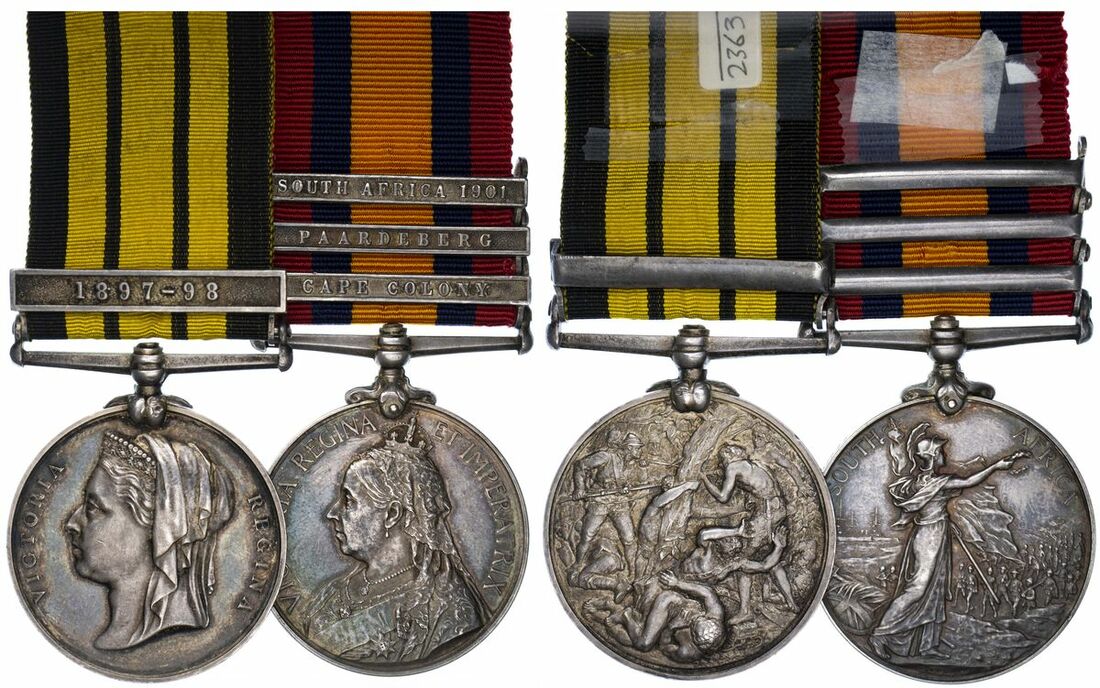
The campaign pair awarded to Civil Surgeon D. J. Menzies-Conacher, attached 3rd Highland Brigade Field Hospital, late Assistant Chief Surgeon, Gold Coast Constabulary, who was taken a Prisoner of War at Zwavel Krans on 4 June 1900, when a convoy of 50 wagons and 160 men of the Highland Brigade surrendered
East and West Africa 1887-1900, 1 clasp, 1897-98 (Asst. C. Surgeon D. J. M. Conacher, G.C. Constby:) officially impressed naming; Queen’s South Africa 1899-1902, 3 clasps, Cape Colony, Paardeberg, South Africa 1901 (D. J. Menzies-Conacher. Surgeon.) officially engraved naming, toned, extremely fine (2)
Duncan John Menzies-Conacher was born in Scotland in 1873 and qualified as a Surgeon at Edinburgh University. He served as Assistant Chief Surgeon with the Gold Coast Constabulary during operations in West Africa from 1897-98. He was Civil Surgeon attached to 3rd (Highland) Brigade Field Hospital in South Africa from 13 January 1900. He was taken prisoner when a convoy of 50 wagons, proceeding from Rhenoster to Heilbron, under Lieutenant Corballis, Reserve of Officers, with 160 men of the Highland Brigade, surrendered at Zwavel Krans, near Heilbron, on 4 June 1900.
‘On the 13th June Civil Surgeon Connacher (sic), who had been taken prisoner with the convoy, was returned to us by President Steyn, and told us its story. He said that the convoy, with an escort of 160 infantry, had left the railway near Roodevaal on the evening of the 2nd June, and had trekked (with one long halt) till eight on the following morning; then, after halting till one in the afternoon, had marched till five, when it had outspanned to the north of the Elands Spruit, near Zwaal Krantz (i.e., nine miles from the railway and fourteen from Heilbron on the Prospect-Heilbron road). There, seeing that there were Boers to the right and front, the commanding officer had sent runners to Heilbron and Vredefort for help, and had extended the men and dug rifle-pits.
They were not molested during the night, but at seven o'clock on the morning of the 4th the Boers sent in a message under a white flag calling on the officer commanding the party to surrender. As the enemy was 4,000 strong, with several guns, he agreed to do this, only stipulating that the mails which he was bringing for the division should be forwarded to Heilbron. This condition was not fulfilled, as the mails were all burnt. Surgeon Connacher said that before leaving Roodevaal the Commandant and the officer commanding the convoy had discussed my telegram to the effect that I considered that the proposed escort was inadequate.’ (The Work of the Ninth Division refers).
When the proceedings of the Court of Enquiry on Lieutenant Corballis were received at the War Office and had been reviewed, it was decided by the then Commander-in-Chief that, in view of his conduct in the matter, Lieutenant Corballis should receive neither the South African Medal nor the war gratuity.
Surgeon Menzies-Conacher, meanwhile, was left sick at Reitz on 7 July 1900, and returned to England later that year on termination of his engagement.
Married at Holy Trinity, Brompton in September 1913, by 1915 he was living with his wife at 19 Thurloe Place, London. Menzies-Conacher died on 8 June 1917 and is buried in Brompton Cemetery.
Subject to 20% VAT on Buyer’s Premium. For more information please view Terms and Conditions for Buyers.
Sold for
£1,100
Starting price
£420
Watch, listen and bid as if you were in the room. Now available for auctions worldwide.
Click here to bid live
An exclusive and confidential service for the discerning collector or vendor.
View the Gallery
Download every Spink catalogue on your iPad, iPod or iPhone using free Spink app.
Download From iTunes© 2026 Spink & Son. All rights reserved.