
Auction: 22133 - Orders, Decorations and Medals - e-Auction
Lot: 45
'Sir Henry knew it "My God, my God," he was heard to say. "And I brought them to this". Handing over command to Colonel Inglis, son of the Bishop of Nova Scotia and former commanding officer of the 32nd, Lawrence rode back to Lucknow to prepare the Residency for the force's reception.'
The words of Sir Henry Lawrence upon seeing the collapse of the British attack at Chinhut, The Indian Mutiny by Julian Spilsbury, refers.
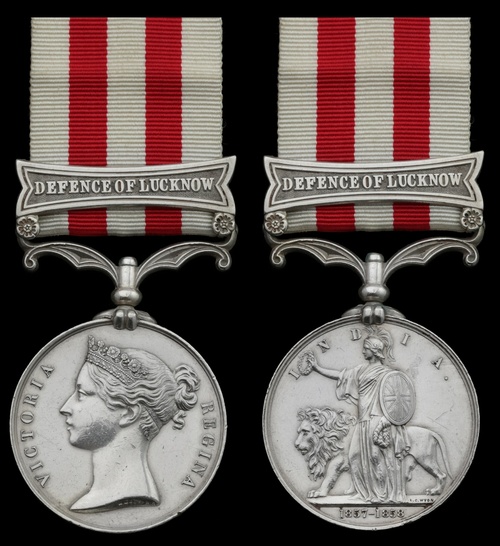
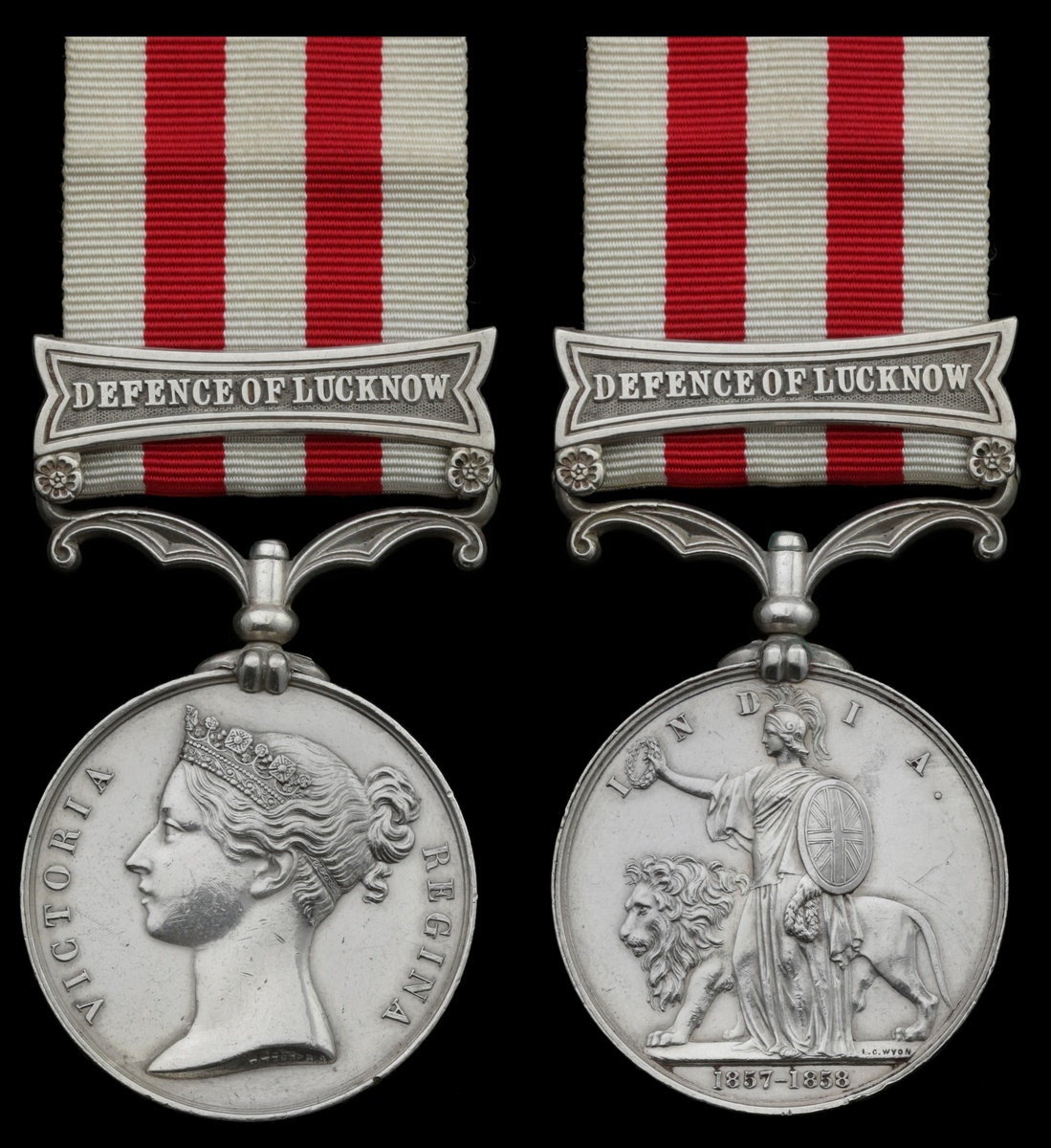
The Indian Mutiny Medal awarded to Corporal W. Simpson, 32nd (Cornwall) Light Infantry, who was wounded in action during the savage action at Chinhut
On that day the Army of Barkat Ahmed drove Henry Lawrence's troops back to Lucknow, the result being the start of the famous Siege of the Residency
Indian Mutiny 1857-59, 1 clasp Defence of Lucknow (Corpl W. Simpson, 32nd L.I.), slight contact wear and edge knocks, overall very fine
54 British soldiers wounded in the action at Chinhut.
W. Simpson was stationed with the 32nd Light Infantry at Lucknow on the outbreak of the Indian Mutiny in 1857.
The Battle of Chinhut - 30 June 1857
With the rising at Cawnpore and the massacre of the garrison, including a company of the 32nd, an army of mutineers led by Barkat Ahmed march on Lucknow. Sir Henry Lawrence, who had spent much of the build up to the mutiny fortifying the residency in preparation for a siege, marched the garrison out to confront the rebels. The two sides met at Chinhut, at the time a village not far outside Lucknow with the British unaware of the size of the force opposing them. This underestimation of the odds led Lawrence to order an attack upon the Mutineers well-fortified position.
The 300 men of the 32nd present were pushed out ahead of the line as a skirmishing force, with the sepoys advancing to their right. Heavy fire from British guns pushed the rebels back and their advance gained momentum, meanwhile whilst- unknown to them- the enemy cavalry began to move about their flanks.
At that moment the mutineers within the British army showed their colours with many of the horse artillery and the Native Police going over the enemy and many others withdrawing in panic toward Lucknow.
The British- and those Sepoys who had remained true- were now fearfully exposed and at that pivotal moment Colonel Case, the commander of the 32nd was struck by a shot from the village. The Chronicle of Private Henry Metcalffe, refers:
'The first man that was killed was Colonel Case, as nice an officer and as good as ever drew a sword. He belonged to my regiment and was only after coming back from England where he had been to get married, so that his wife very soon became a widow, as so did a good many more before the struggle was over.'
Under a withering fire and with their Colonel dead the impetus left the advance of the 32nd and they moved to find cover rather than attack. The call to withdraw was made and in the confusion the rebel horsemen who had been infiltrating their flanks struck.
The British would doubtless have been overwhelmed had it not been for the bravery of the much-outnumbered Volunteer Cavalry. As it was many still fell during the withdrawal, either overtaken by the sabres of rebel Sowers or dropping out through heat exhaustion.
Simpson was wounded during the fighting but managed to survive the retreat, he may even have been one of the lucky soldiers seen being carried by the sepoys who had remained loyal. Their efforts to bring their British comrades out from under the swords of the rebels and back to Lucknow did a great deal to mend the mistrust sown by the defection of the Native Police and Artillery during the battle and during the siege they were to perform admirably on the walls.
After a hellish retreat harried all the way by the enemy survivors of the column streamed over the Iron Bridge and back into Lucknow, there to prepare themselves for the arrival of their victorious enemy.
Wounded during the Siege of Lucknow
Simpson was wounded during the siege and likely spent the majority of it in the hospital, this was not to say that he had an easy time of it. The diary of L. E. Ruutz Rees covers the appalling conditions faced by those wounded, stating:
'Many of the wounded were lying groaning upon mattresses and cloaks only. Everywhere cries of agony were heard, piteous exclamations for water or assistance. The fumigations to which recourse was had were not sufficient to remove the disagreeable, fetid smell which pervaded the long hall of the sick and the air in it was pestilential and oppressive.'
The hospital- like most places within the Residency- was also open to fire from enemy guns with both the wounded and those tending to them being killed by enemy fire whilst helpless. By the end of the siege the vast majority of the regiment was wounded with Metcalfe suggesting that of the 950 men who arrived at Lucknow only 250 were uninjured, he quotes Sir Colin Campbell saying:
'The General, on beholding what was left of the once gallant 32nd said, "On my honour, Brigadier, you have a motley crowd to command and more like an invalid Depot than the once fine regiment who fought with me on the Punjab and on the North-West Frontier'
(The Chronicle of Private Henry Metcalffe, refers)
Despite his wound and the savage fighting of the siege, Simpson survived to claim his Indian Mutiny Medal; sold together with a casualty roll.
Subject to 20% VAT on Buyer’s Premium. For more information please view Terms and Conditions for Buyers.
Estimate
£2,500 to £3,000
Starting price
£2300
Watch, listen and bid as if you were in the room. Now available for auctions worldwide.
Click here to bid live
An exclusive and confidential service for the discerning collector or vendor.
View the Gallery
Download every Spink catalogue on your iPad, iPod or iPhone using free Spink app.
Download From iTunes© 2026 Spink & Son. All rights reserved.