
Auction: 21102 - Orders, Decorations and Medals e-Auction 3
Lot: 144
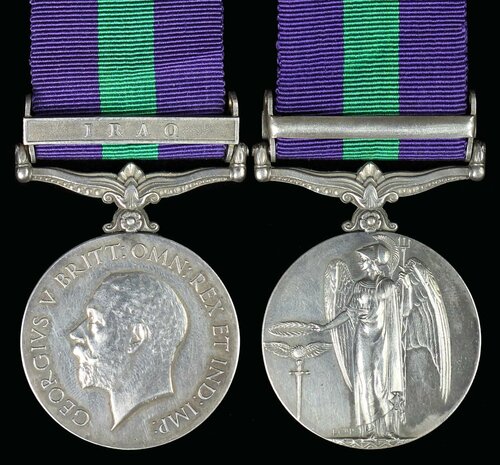
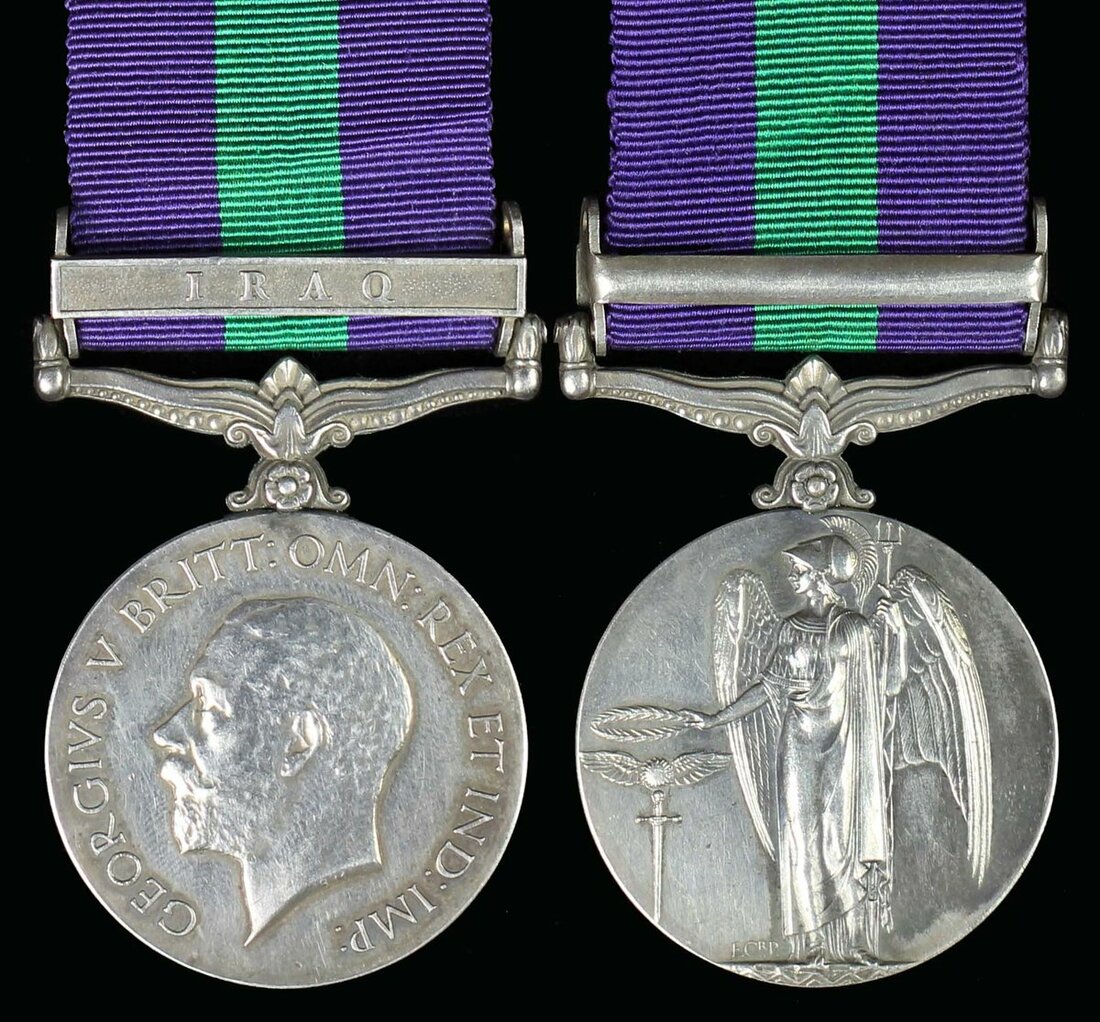
General Service 1918-62, 1 clasp, Iraq (Lieut. F. W. Mantle. R. Lanc. R.), unofficially re-impressed naming, very fine
Frederick William Mantle was born at Magdeburg, Germany on 28 January 1884, the son of a British Consul. He claimed to have had the "advantage of a University education" at Heidelberg. Mantle went to sea as a Midshipman in 1902 and obtained his first certificate in 1906, when he entered service with the Peninsular & Oriental Steam Navigation Company. He was a Junior Officer of the P&O Company 1906-1916, resigning with the rank of Chief Officer and holding a Master Mariner's certificate.
Mantle then joined the Army as a Lieutenant with the Royal Engineers and in 1917 he was the Officer Commanding munition convoys between England and France. Port Officer at Naramar (Basra, Mesopotamia) from 1918, he worked on the River Survey and Buoyage Service on the Tigris and Euphrates rivers. In 1919 Mantle was Embarkation Staff Captain at Amara. Regarded as a "capable, energetic and reliable officer", Captain Mantle "performed excellent service" during the 1920 "Great Iraqi Revolution" when he was stationed in the Lower Euphrates.
On demobilisation, Mantle joined the Australian Commonwealth Line, but in July 1924 applied for appointment as a District Officer in New Guinea. He wrote in his letter of application of 10 July 1924 to the Secretary, Department of Home and Territories, that he "...had considerable experience in administrative matters as well as experience in dealing with natives both Arab and Indian". He had "frequently worked in conjunction with the Political Service and consequently gained an insight into the ruling of natives and the working of the tribal laws". He spoke and wrote German "fluently" and had "a good command" of French and Hindustani. When on leave in London in 1919 he had passed the Civil Service examination for the Consular Service but, so he wrote in his application, "owing to the enormous number of candidates, most of them of high military rank', he had failed to obtain an appointment. "
Mantle visited the Department and was told there was no suitable vacant position in New Guinea, although someone wrote on Mantle's file that he "deserves a permanent appointment". Mantle wrote again in 1924 pressing his case for an appointment. In 1925 he somehow managed to meet with Senator Pearce, Minister for Home and Territories, with a letter of introduction from William Watt, Speaker of the House of Representative, asking that Mantle be interviewed for a position on the New Guinea staff. In August 1925 Hubert Murray met with Mantle in Melbourne and recommended him for appointment as a Deputy District Officer. He was appointed as of 17 September 1925.
In 1927, when Keith McCarthy arrived in Rabaul, Mantle was the ADO, "...and he looked the part. His thick grey hair well set off his good looks and distinguished bearing", but what impressed McCarthy was the monocle he wore on a black cord. "When Mantle screwed it into his eye he spoke with a voice that went well with a monocle. 'Delighted to meet you, McCarthy', he said. 'Later I will introduce you to the Club, where my vast experience will be available to you while we drink. You will have the opportunity of paying for the drinks'." He spoke German "even better than he did English". McCarthy wisely declined to play bridge or poker with Mantle. McCarthy, looking at Mantle's "white duck magnificence", asked about clothes, for he had no tropical kit. " 'Certainly', said Mantle, and he rang a bell. 'I will send you to Ah Teck. He is very good and does not dun you with bills. Not that anyone pays his tailor'."
Mantle served as Area District Officer and District Officer in regions including Gasmata, Kavieng, Namatanai, Manus Ireland and Aitape.
In 1938, having completed the course at the University of Sydney then undertaken by all Cadets, the newly promoted Patrol Officer John Murphy was posted to Rabaul under the supervision of District Officer Freddie Mantle, who assigned him to establish a Police Post at Arung Bay in Passimanua on the south-west coast of New Britain, "where the Kowlongs inland were causing a bit of trouble". Murphy noted in his memoirs that "Freddie was an ex British Navy Officer, with two pretty daughters, Sheila and Robyn. He was a gregarious bloke but considered that Patrol Officers had to rough it to render themselves worthy of their later rank of Assistant District Officer and District Officer. Most Sunday mornings the Field Staff turned up at Freddie's place for a bit of socialising. I didn't drink in those days so I can't recall if any liquor was served. I don't think any of us young Patrol Officers and Cadets, except [John] McLeod, grogged on much as a rule. All of us tried to sit next to Sheila."
At the outbreak of the Second World War, Mantle was a District Officer Grade 2, was a Magistrate at Rabaul having returned there from leave in November 1941. Dorothy and their children remained in Sydney because of the unsettled position at that time. Mantle lost his life on the Montevideo Maru on 1 July 1942. On 22 June 1942, some weeks after the fall of Rabaul to the Japanese, a large number of Australian prisoners were embarked from Rabaul's port on Montevideo Maru. Unmarked as a POW ship, she was proceeding without escort to the Chinese island of Hainan, when she was sighted by the American submarine Sturgeon near the northern Philippine coast on 30 June.
Sturgeon pursued, but was unable to fire, as the target was travelling too fast. However, it slowed at midnight, according to crewman Yoshiaki Yamaji, it was to rendezvous with an escort of two destroyers. Unaware that it was carrying Allied prisoners of war and civilians, Sturgeon fired four torpedoes at Montevideo Maru just before dawn. She sank in 11 minutes. According to Yamaji, Australians in the water sang "Auld Lang Syne" to their trapped mates as the ship sank beneath the waves:
'There were more POWs in the water than crew members. The POWs were holding pieces of wood and using bigger pieces as rafts. They were in groups of 20 to 30 people, probably 100 people in all. They were singing songs. I was particularly impressed when they began singing Auld Lang Syne as a tribute to their dead colleagues. Watching that, I learnt that Australians have big hearts.'
The sinking is considered the worst maritime disaster in Australia's history. A nominal list made available by the Japanese government in 2012 revealed that a total of 1054 prisoners lost their lives; sold together with copied research.
Subject to 20% VAT on Buyer’s Premium. For more information please view Terms and Conditions for Buyers.
Sold for
£80
Starting price
£50

Watch, listen and bid as if you were in the room. Now available for auctions worldwide.
Click here to bid live
An exclusive and confidential service for the discerning collector or vendor.
View the Gallery
Download every Spink catalogue on your iPad, iPod or iPhone using free Spink app.
Download From iTunes© 2026 Spink & Son. All rights reserved.